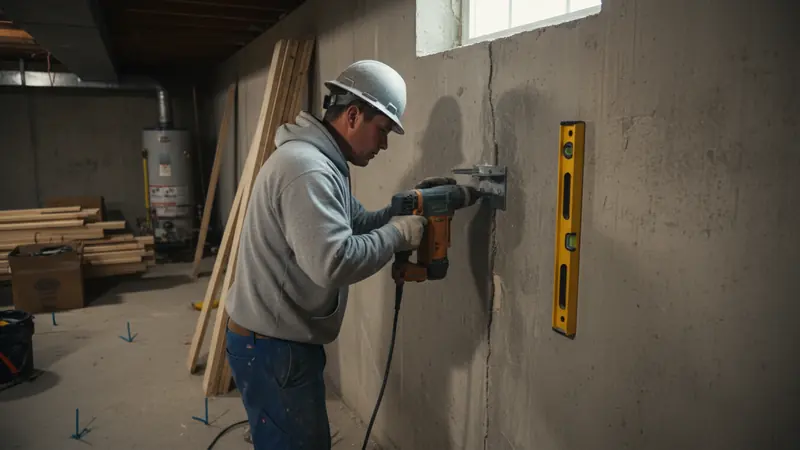
What the County requires. What you pay for a permit. How to tell a wet basement from a foundation that needs structural work.
We date every figure when we gather it. Where a source leaves a question open, we say so.
Do you actually need a permit?
Plan on a building permit for structural foundation repair. Rebuilding a supporting wall is more than routine surface maintenance. So is changing a load-bearing support or underpinning an existing footing. Treat it that way even if your contractor calls it a repair.
The Residential Code exempts ordinary repairs from permits. The 2024 IRC, section R105.2.2, excludes cutting away walls from that exemption. It also excludes removing or cutting structural beams or load-bearing supports. Howard County adopts that code edition with local amendments. We read this to mean that changes to how your house is supported need County building-permit review.
The rules are less clear for a nonstructural crack seal, surface patch or waterproofing-only job. We could not find a County policy that classifies every foundation-repair product or method separately.
The scope decides the answer. Do not assume every crack injection is exempt. Nor does every waterproofing treatment necessarily need the same permit. Send DILP a description of your proposed work. Include excavation, drainage changes and structural attachments. The County's permit-information number is 410-313-2455, option 4. An answer about sealing a surface crack does not cover installing structural reinforcement behind it.
Source: International Code Council, 2024 IRC, Chapter 1, section R105.2.2; Howard County DILP, Adopted Codes, local adoption effective 2025-09-07, and General Contact Information, undated. Structural-work classification above is an application of the code distinction, subject to DILP's scope review. Gathered 2026-09-22.
What the permit costs
The FY2027 building schedule took effect on 1 July 2026. It lists residential alteration and repair fees separately from its foundation-permit entry.
| Residential alteration or repair item | Published charge |
|---|---|
| Nonrefundable filing charge | $25 |
| One small room or work area, at most 200 square feet | $50 permit charge |
| Larger category: over 200 square feet, described as more than a single floor or area | $100 permit charge |
| Technology surcharge | 10% |
Confirm the category. We use the residential-repair category as a starting point for repairs to an existing single-family house. The schedule does not explain how to measure the area affected by piers or wall reinforcement. Its separate $200 plus filing fee foundation entry requires prior approval. You must also pay the associated building and utility fees. The schedule does not say this price covers every foundation repair. Ask DILP to confirm which category applies. Ask how to measure the area too.
The administration schedule bases the technology charge on a percentage of the permit or licence fee. It does not clearly say how the separate filing charge is treated. We cannot give you an all-inclusive total from that. Confirm both questions at 410-313-2455, option 4.
Source: Howard County DILP, FY27 Building Permit Fee Schedule, page 1, and FY27 Administration, page 1; Council Resolution 83-2026, effective 2026-07-01. Gathered 2026-09-22.
The fees that can appear after work starts
Ask for the original application fee to be listed separately from charges for later changes or failed inspections. The current administrative charges below may apply if your repair changes after excavation exposes the foundation.
| Event | Published charge |
|---|---|
| Residential application revision after the first; any revision after approval for issuance or issuance | $50 per revision |
| Extension or reactivation | $50 per 90 days, extensions totalling no more than one year |
| Second failure of the same inspection | $100 |
| Third failure of the same inspection | $125 |
| Fourth or subsequent failure of the same inspection | $175 |
| Starting work without the required permit | $100 |
These fees cover administration, not engineering, excavation or rebuilding. A revision charge does not pay for your contractor's extra work either. Put who handles an amended design in your contract. Settle who gets County approval. Agree who pays any resulting inspection charges. This matters especially if the exposed foundation differs from what your contractor priced for.
Source: Howard County DILP, FY27 Administration, page 2; Council Resolution 83-2026, effective 2026-07-01. Gathered 2026-09-22.
What goes into the application, and how long it takes
Howard County requires electronic residential building applications. Give an accurate description of the work. Include the drawings or dimensions and specifications its residential checklist calls for. Supply contractor and licence information where applicable. You may also need a plot plan, existing and proposed floor plans, or association approval. If you act as general contractor at your primary residence, you can apply without the professional registration form.
Make it clear what you want to change. Identify the affected wall or support. Distinguish the existing structure from new work. Show where you propose to excavate. Mark where you will attach structural supports. A repair-system sales brochure does not explain where it goes in your house or how much work you need.
Do all repair plans need an engineer's seal? The County checklist requires signed and sealed plans “if applicable”. It gives no blanket exemption for foundation repairs. It does not say every repair needs sealed plans either. Our reading is that you need to settle this for your actual design. DILP Plan Review handles the County's technical interpretations. The checklist lists 410-313-2436 for plan review and fee assessment.
We could not verify a median approval time specifically for Howard County foundation repairs. Nor could we verify a published turnaround commitment. General building-permit figures would mix these repairs with unrelated projects.
The County reviews construction documents before issuing a permit. It sends comments if you need to make corrections. It works with other offices where needed. Before relying on a proposed start date, check whether you are still waiting for permit approval. Applying does not mean you are ready to excavate.
Source: Howard County DILP, Residential Miscellaneous and Addition Building Permit Checklist, revision 2023-12-18, and Plan Review Division, undated. No foundation-specific timing figure verified in these published materials. Gathered 2026-09-22.
The inspections
The County's booking list includes these building inspection codes for foundation and drainage work. Your repair may not need every inspection listed. Settle which stages your approved work needs before you cover anything up.
| Code | County inspection category |
|---|---|
| 207 | Footings |
| 208 | Foundation walls / dampproof |
| 201 | Damproof and draintile |
| 202 | Draintile |
| 217 | Slab and draintile |
| 205 | Final building |
Once your permit is issued, you can book an inspection for the next day. You can also book up to seven working days ahead. Call 410-313-3800, or text Schedule to 888-297-9841. Follow the prompts. You can get the results on the day of the inspection.
For a two-hour arrival window, call 410-313-1823 between 7:30 and 8:30 a.m. on inspection day. Building inspection questions go to 410-313-1810.
Keep your permit number and inspection results with your repair records. A photograph is a useful record of completed work. It does not prove that the County approved the required inspection.
Source: Howard County DILP, Automated Inspection Request and Permit Information System / Inspection Scheduling Instructions, posted version dated 2025-04-14; first-sheet footer dated 2024-12-27. Gathered 2026-09-22.
What the inspector is actually going to check
Howard County publishes a residential foundation dampproofing checklist. Where it applies to your work, you need to meet these requirements:
- Apply ⅜-inch Portland-cement parging to masonry foundation walls enclosing usable or habitable space. Cover from the footing to finished grade.
- Apply approved dampproofing over the concrete or parged masonry. Cover that same height.
- Use waterproofing instead of merely dampproofing where high groundwater or severe soil-water conditions exist. Overlap the membrane joints. Seal them.
- Install approved drainage where the crawl-space floor is below outside finished grade.
- Have foundation walls retaining unequal soil levels properly designed. Have them properly installed. They are checked against section R404.
Your repair needs to account for the water conditions. It also needs to account for what the wall supports. A coating specification alone does not answer both questions.
Limits of this checklist. The checklist is undated. It is not specifically for underpinning or proprietary piers. Do not use it to assume a standard pier depth, spacing or capacity. Settle your repair details through the approved plans and DILP's inspection requirements. The Plan Review Division handles code interpretation.
Source: Howard County DILP, Inspection Requirements, Residential Building — Damproofing, undated; applicability to an existing repair depends on its approved scope. Gathered 2026-09-22.
Floodplain and historic-property rules can change the job
Inside the floodplain, do not rely on the ordinary permit exemptions. The County's floodplain notice requires a building permit for changes and improvements to structures there under section 16.706. Its definition of development includes excavation, filling, grading and drilling, as well as building work. The notice expressly says building-code permit exceptions do not apply to structures in the floodplain.
To check whether your property is in the floodplain, the County directs you to its DFIRM tool. You can also contact the Stormwater Management Division at 410-313-6444. Check your actual property and proposed work area. An Ellicott City postal address does not mean every house faces the same floodplain restrictions.
Check historic status separately. Howard County's Historic Preservation Commission reviews exterior repairs and alterations affecting covered historic properties and districts. It has a process for deciding whether an alteration is minor. Your proposal may not need a full Commission hearing. Preservation staff can explain the process at preservation@howardcountymd.gov.
The Commission says its application submissions carry no fee. You may still have to pay for a building permit. For an exposed foundation repair, settle the exterior materials and appearance before you finalise the work specification.
Source: Howard County DILP, Improvements to Structures Located in the Floodplain, undated notice posted April 2026, citing County Code sections 16.701 and 16.706; Howard County DPZ, Historic Preservation Commission, current undated guidance. Gathered 2026-09-22.
Who is allowed to do the work, and which code applies
Maryland's Home Improvement Commission lists work that usually requires its licence. This includes foundations, nonmarine piers, waterproofing, excavation, and structural house lifting and reattachment. For a qualifying home-improvement contract, the business you hire directly must hold an MHIC contractor licence.
Subcontractors may work under an MHIC-licensed contractor without a separate MHIC subcontractor licence. That does not mean an unlicensed business can contract directly with you for the same work. You can check licence status on the Commission's website.
MHIC says its home-improvement coverage excludes commonly owned condominium areas. It also excludes buildings containing four or more single-family units. For a shared condominium foundation, check which contracting requirements apply. Do not assume advice for a detached house covers it.
Howard County lists the 2024 International Residential Code and International Building Code with County amendments as its building codes. These took effect on 7 September 2025, under Council Bill 24-2025. The provisions that govern your repair depend on the building and proposed work. Contractor licensing, design acceptance and inspection approval are separate steps. A licence does not mean the proposed structural design has been approved.
Source: Maryland Department of Labor, What Is Home Improvement?, revised December 2018, and Maryland Home Improvement Commission, current undated licensing guidance; Howard County DILP, Adopted Codes, adoption effective 2025-09-07. Gathered 2026-09-22.
What Howard County houses are, and what can go wrong beneath them
The 2020–2024 ACS five-year estimates put Howard County's housing stock at 125,286 units. Of those, 62,770 are in detached single-unit structures. Another 28,061 are attached single-unit homes. The age figures include 28,675 homes built in 1980–1989. They also include 21,050 built in 1970–1979.
These survey estimates do not tell us the condition of the foundations. For example, the estimated count built in the 1980s has a margin of error of ±1,155. The figures show that much of the housing stock is several decades old. They do not tell us how many homes have cracked block, deteriorated mortar, failed drainage or settlement. We found no County primary-source breakdown of failure rates by foundation type or neighbourhood.
Source: U.S. Census Bureau, ACS 2020–2024 five-year estimates, housing characteristics, as published by the Maryland Department of Planning's State Data Center in its Howard County ACS report. Counts cover all housing units, not only occupied homes. Gathered 2026-09-22.
The County's geological description does not support the same soil diagnosis for every address. Its solid-waste plan describes crystalline bedrock beneath much of Howard County. Along the eastern edge, from Elkridge to Laurel, the Patuxent Formation lies over it. Groundwater moves through fractures in the bedrock. Conditions vary with location and topography.
That describes the region, not the soil at your house. Our reading is that a county name cannot tell you what your footing rests on. It cannot tell you where suitable supporting ground lies. Nor can it tell you whether your lot has troublesome groundwater. The document does not support a universal pier depth. It does not support an expansive-clay diagnosis either.
Source: Howard County Department of Public Works, 2025–2034 Solid Waste Management Plan, section 4.11.3, Geologic Conditions/Aquifer Characteristics, document accompanying CR143-2025, posted July 2025. Used only for its county geological description, not as a residential engineering standard. Gathered 2026-09-22.
For a wet basement, the County gives more immediate advice. If your sump pump runs continuously, its Stormwater Management page says to check where your downspouts point. Consider a broken water line. Investigate high groundwater through the Howard Soil Conservation District. The County directs excessive surface flow and neighbourhood drainage problems to Construction Inspection. For utility-related sinkholes, it directs you to the responsible utility or highway office.
Start by recording when the water appears. Note where it enters. Work out whether it involves roof runoff, a utility, groundwater or wider drainage. Those observations help describe the problem. They do not prove your foundation needs structural reinforcement. If you receive a water-management proposal, ask whether structural concerns are being checked separately.
Source: Howard County Bureau of Environmental Services, Stormwater Management, “Who should I contact?”, undated current guidance. Gathered 2026-09-22.
What the work is worth, and what a quote needs to say
We could not find a reliable series of installed prices for Howard County foundation repairs. We cannot give a defensible local median for crack injection, wall reinforcement, underpinning or foundation replacement. Permit charges are not construction prices. A price per pier is incomplete without a defined design and installation scope.
Maryland does give you contract protections. MHIC requires a written, signed agreement. It must describe the work and materials. It must identify the contractor and licence number. It must give approximate start and substantial-completion dates. You must receive a signed copy before work begins. The Commission says the initial deposit cannot exceed one-third of the contract price. Your contractor cannot accept payment before signing.
Ask practical questions about the proposed repair. What condition will it correct? Which wall or support does it cover? Who supplies the design? Who gets the permits? What happens if excavation reveals a different condition? Does the price cover drainage, backfill and finish repairs? Does it cover getting the required inspections signed off? These questions are suggestions, not a County price formula. They help you compare proposals without inventing a local average.
Source: Maryland Department of Labor, Maryland Home Improvement Contracts, current undated guidance. No Howard County foundation-repair installed-price series verified during this research. Gathered 2026-09-22.
The short version
Describe the structural work separately from the drainage work. Settle the permit category before accepting a fee allowance. Agree which inspection stages you need before excavation. Check floodplain status early. Check historic status too. Make sure your repair paperwork links the diagnosed problem to the approved work. Keep the inspection results afterwards.
Howard County gives you useful requirements and published administrative charges. It does not supply the missing facts about your footing, your soil or the right repair price for your house. You need those answers from the site assessment and a proposal that clearly describes the work.
Source: Howard County DILP, Plan Review Division, undated, and Resources & Fees, linking the FY2027 schedules effective 2026-07-01; summary of the scope limitations documented above. Gathered 2026-09-22.